Commercial Water Damage in Mount Vernon, WA
A burst sprinkler pipe, a roof drain or a flooded storefront can stop a business cold. The response team extracts the water, sets up drying in phases so parts of the space can stay open and documents everything for the commercial claim.
(888) 509-1696Business flooded? Get the water out now- Phased drying plans
- After-hours work
- Commercial claim files
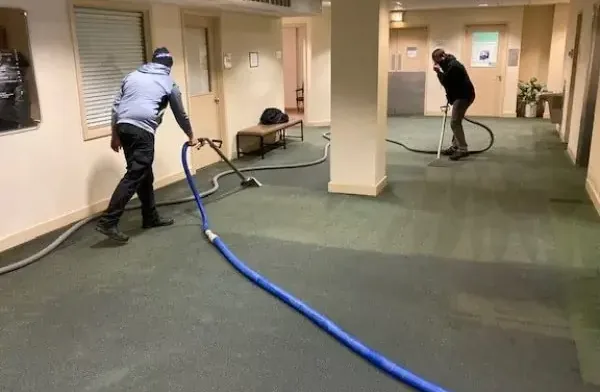
First steps for commercial water damage
Shut off the source
Close the sprinkler zone valve, the main or the fixture shutoff.
Clear people from wet areas
Keep staff and customers away from water and wet electrical gear.
Protect records and stock
Move documents, inventory and electronics off the floor.
Call the property manager
Let the owner or manager know so other units can be checked.
The standard behind commercial water damage
Rapid local response
Dispatch runs 24/7, and an active leak, flood or backup is treated as urgent on nights, weekends and holidays.
IICRC S500 drying standard
The drying team maps moisture first, sizes air movers and LGR dehumidifiers to the load and keeps them running until the readings say dry.
Claim-ready documentation
Timestamped photos, the moisture map and daily drying logs go into one file an adjuster can follow.
Skagit Valley water know-how
Crawl spaces, river floodplain lowlands, damp winter air and hard freezes all change how water moves through a house here.
What does commercial water damage cost in Mount Vernon, WA?
Commercial water damage restoration here typically runs $3,000 to $40,000 or more, depending on the square footage, the water category, how many suites or units were reached and how much work has to happen after hours.
Single suite or storefront
$3,000 to $8,000- Extraction and drying
- Containment from open areas
- Claim documentation
Several suites or a full floor
$8,000 to $20,000- Phased drying plan
- Units below checked
- After-hours work
Building-wide or Category 3
$20,000 to $40,000+- Large containment
- Porous materials removed
- Long dry-out and logs
Ranges are typical, not a quote. Water category, square footage, material class and how fast drying started move the number most. The water damage cost calculator gives a planning range.
How commercial water damage is handled, step by step
- 1
Assess and plan
A walkthrough maps the water and sets a phased plan with the owner.
- 2
Extract and contain
Water comes out and wet areas are sealed off from open ones.
- 3
Dry in phases
Equipment is placed so each area can reopen as it dries.
- 4
Document and hand back
Logs, photos and the scope go to the owner and adjuster.
Commercial water losses come from the same sources as homes, only bigger: fire sprinkler pipes, roof drains on flat roofs, water heaters in back rooms, restroom backups and, near the river, floodwater. Downtown storefronts, College Way retail, medical offices, restaurants and apartment buildings all have different needs, but each one wants the doors open again as fast as possible.
Keeping the business running
The response team plans the work around the business.
- Drying in phases, so unaffected areas stay open
- Containment walls that separate wet areas from customers and staff
- After-hours and weekend work where noise or access is a problem
- Coordination with property managers, tenants and building owners
For apartments and mixed-use buildings, one leak often reaches several units, so every unit below and beside the source gets checked with meters.
Safety and documentation
Commercial cleanups follow the same Category and Class rules as homes, plus workplace safety. OSHA's flood cleanup guidance covers electrical, slip and contamination hazards, and Ready.gov's business page helps owners plan for the next flood or outage. The claim file carries moisture maps, daily drying logs, photos and an itemized scope, which commercial adjusters expect.
Floodwater and sewage in a business
When river water or sewage gets inside a commercial space, it is Category 3, and porous materials it touched come out under containment. See flood water cleanup and sewage backup cleanup for those losses, and structural drying for how large spaces are dried.
Commercial water damage across Mount Vernon and nearby towns
Drying crews cover ZIP 98273 and 98274, from Downtown and the west side river flats to Hillcrest, the Kulshan Creek and Maddox Creek neighborhoods, Little Mountain, Eaglemont and Skagit Highlands.
Coverage also reaches Burlington, Sedro-Woolley, La Conner, Conway, Big Lake, Bay View, Anacortes, Stanwood and Oak Harbor.
Related water damage services
Commercial Water Damage questions, answered
Can a business stay open during water damage restoration?
Often, partly. Containment walls and phased drying let unaffected areas keep working while the wet areas dry.
Can drying be done after hours?
Yes. Noisy work and access-heavy steps can be scheduled for nights and weekends, though drying equipment runs around the clock.
Who coordinates with tenants in an apartment building?
The response team works with the property manager to check and dry every affected unit and keep tenants informed.
Does commercial property insurance cover water damage?
Sudden losses like a burst sprinkler pipe are often covered, and some policies add business interruption coverage. Coverage depends on your policy, so check with your own insurer.
How long does commercial drying take?
Usually three to seven days, depending on the size of the space and the materials, such as concrete floors or plaster walls.
What if floodwater got into the building?
River water is Category 3. Porous materials it touched are removed under containment, then the structure is cleaned, treated and dried.
Business taking on water? Get the response team moving.
Water in a commercial space spreads across large floors and into neighboring units fast. The response team extracts it, contains it and dries it in phases.