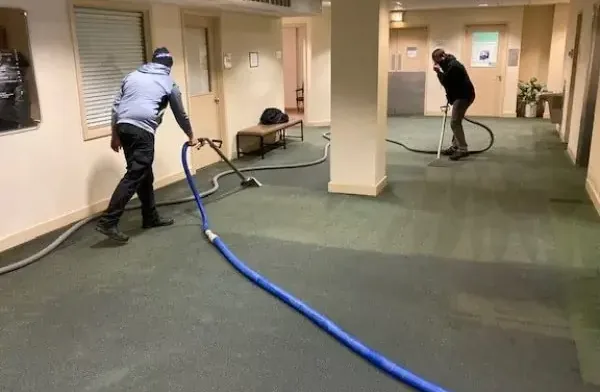
A fire on July 24, 1911, destroyed nearly all of the business center in Sedro-Woolley, and the historic downtown that rose after it is mainly brick. Brick storefronts hold up well, but when water gets in, thick walls and old floors dry slowly, and an owner needs a plan before the doors have to stay closed.
Key takeaways
- Stop the water source first, then protect stock, records and equipment above the wet floor.
- Brick, plaster and old wood dry more slowly than new drywall, so moisture readings direct the work, not appearances.
- Phased drying lets part of a shop reopen while the wettest area is still being worked on.
- Photos, a stock list and a daily log of the work protect the claim and speed up decisions.
- Losses in the city run from small storefronts to large work buildings, and each needs its own drying plan.
The first day for a shop or office owner
The first hours set the size of the loss. A business owner should work through a short order: safety, source, protection and photos.
Water in a commercial space can come from a split supply pipe, a failed fixture upstairs, a roof drain, a rooftop unit or a heavy storm. Finding where it started comes before drying anything.
- Shut off the water at the main valve if a pipe or fixture is the source.
- Turn off power to wet areas and keep staff and customers out of them.
- Lift stock, paperwork and electronics onto shelves, counters or a dry room.
- Photograph the damage, the source and every item that was wet.
- Call a restoration crew and the building owner or landlord, if the space is leased.
Why a brick downtown dries differently
Brick and the plaster that often sits behind it hold water in small pores. Old wood floors and joists absorb it and give it back slowly.
That means a storefront can feel dry to the hand while the walls are still wet inside. Moisture readings in the masonry, the baseboard and the subfloor tell the real story.
Hidden moisture in thick walls
Water wicks upward and sideways in brick. A small ceiling leak can leave a damp patch much larger than the stain on the surface.
A thermal camera helps trace where the moisture went, and pin meters confirm the numbers at the wall base and behind finishes.
Floors and fixtures
Hardwood, tile over old subfloors and built in shelving all react differently. Some can be dried in place, and some must be lifted to let the framing underneath dry.
Phased drying: keeping the doors open
A business loses money every day it is closed, so the dry out is planned in zones. The commercial water damage approach is to contain the wet area and keep the rest of the space in use where it is safe.
Phase one: stop, contain and extract
The water source is stopped and standing water is pulled out. Plastic barriers and negative air can keep dust and moisture from the dry side of the shop.
Phase two: open up and dry
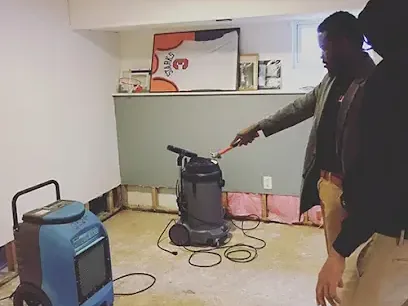
Wet baseboard, lower drywall and trapped insulation are removed where needed, and drying equipment is set. The structural drying stage runs until the masonry, framing and subfloor reach the dry standard for each material.
Phase three: verify and restore
Readings are repeated, equipment is removed, and finishes are replaced in an order that lets the shop reopen in steps. Painting and fixture reinstall usually come last.
Stock, records and customers
A water loss in a shop is a business interruption as much as a building problem. A little preparation keeps both under control.
- Keep a stock list with photos so wet or lost items can be counted.
- Move paper records and electronics first, since they are hard to restore.
- Tell regular customers and delivery drivers where the shop stands, so they are not surprised.
- Ask the crew for a written scope and a daily log of the work.
- Keep receipts for emergency purchases, such as tarps, fans and temporary storage.
Where the water comes from in an older commercial building
Older commercial buildings have many places for water to enter, and a leak can travel before it shows. Knowing the common sources helps an owner describe the problem to a crew.
Water that appears at a ceiling or wall base may have started a long way from where it shows.
- A split or loose supply pipe in a wall, ceiling or upstairs unit.
- A failed restroom fixture, water heater or dishwasher in a back room.
- A roof drain, scupper or flashing that backs up in a heavy storm.
- A rooftop heating or cooling unit with a blocked condensate drain.
- Rain water that finds a gap at a window, door or wall joint.
From storefronts to large work buildings
Sedro-Woolley is not only a downtown of small shops. Large employers include Janicki Industries, the PeaceHealth United General Medical Center District, the Sedro-Woolley School District and the Cascades Job Corps Center.
A leak in a manufacturing floor, a clinic or a school campus is a different job from a storefront. Open floors, large roofs and equipment loads change how water spreads and how drying equipment is set.
The same questions apply at any size: what is the source, how far did the water go, and what has to stay running while the crew works.
A larger building follows the same plan on a bigger scale, as the commercial water damage approach for the wider area explains, and owners can see local options on the Sedro-Woolley service pages.
What to ask a restoration crew
Before work starts, an owner can ask a few direct questions. The answers show whether the plan fits the building and the business.
- Which areas will be dried first, and can any part of the shop stay open?
- How will the crew measure when masonry, framing and subfloor are dry?
- What gets removed, and what is saved and dried in place?
- How often will readings be taken, and who gets the daily log?
- What happens to stock and fixtures that were wet?
Questions
How long does a brick storefront take to dry after a leak?
A typical dry out takes several days, and thick masonry or old plaster can take longer. The crew checks readings daily and stops only when the materials meet the dry standard.
Can part of a shop stay open during drying?
Often, yes. The wet area can be sealed off with barriers while the rest of the space remains in use, if power, air quality and safety allow it.
What comes out first after a leak in a retail space?
Standing water, then wet baseboard, lower drywall and insulation that is holding moisture. Stock and furniture are moved before the floor is worked on.
Should a tenant call the building owner or a restoration crew first?
Both, and quickly. The crew starts stopping damage, and the owner needs to know about the source, especially if the leak came from a pipe, roof or unit that is not the tenant's.
Does the 1911 downtown fire matter for water damage today?
It explains why so much of the historic downtown is brick. The material dries slowly, which is why readings, not appearances, decide when a storefront is ready to restore.