Water Extraction and Removal in Stanwood
Flooding in early December 2023 affected local homes and businesses, and January 2026 storms and a king tide damaged the Skagit Bay Dike. Whatever the source, extraction comes first, because standing water keeps soaking materials that drying alone cannot save.
(888) 509-1696Ask about water removal- Truck-mounted units
- Pad and carpet checks
- Moisture mapping
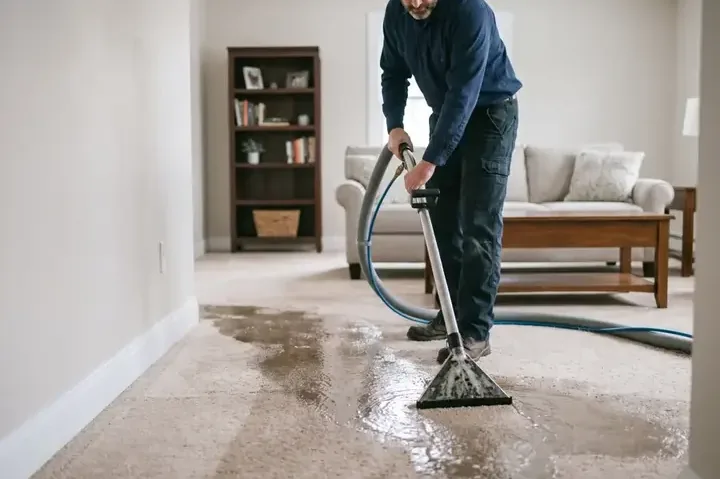
First steps for water extraction and removal
Check the power
Stay out of standing water until the breakers for that area are off.
Stop the source
Close the main valve or the appliance supply so no more water joins what is already there.
Lift the small items
Raise rugs, books and electronics out of the water.
Leave the carpet alone
Walking on soaked carpet pushes water deeper into the pad and spreads it to dry rooms.
The standard behind water extraction and removal
Rapid local response
Dispatch runs 24/7, and an active leak, flood or backup is treated as urgent on nights, weekends and holidays.
IICRC S500 drying standard
The drying team maps moisture first, sizes air movers and LGR dehumidifiers to the load and keeps them running until the readings say dry.
Claim-ready documentation
Timestamped photos, the moisture map and daily drying logs go into one file an adjuster can follow.
Skagit Valley water know-how
Crawl spaces, river floodplain lowlands, damp winter air and hard freezes all change how water moves through a house here.
What does water extraction and removal cost in Stanwood, WA?
Extraction cost follows the area and the floor type. One room of carpet sits in the first range, several rooms or a hallway in the second, and hardwood with pad removal in the third.
A single carpeted room
$600 to $1,500- Carpet extracted in passes
- Pad tested with a probe
- Air movers set up
Several rooms or a hallway
$1,500 to $3,000- Extraction across connected rooms
- Moisture map recorded for the claim
- Dehumidifiers sized to the space
Hardwood and pad removal
$2,500 to $4,000- Drying mats under wood planks
- Wet pad cut out and bagged
- Baseboards pulled where wicked
Ranges are typical, not a quote. Water category, square footage, material class and how fast drying started move the number most. The water damage cost calculator gives a planning range.
How water extraction and removal is handled, step by step
- 1
Secure
Power is checked, hazards are marked and the water category is judged before extraction starts.
- 2
Extract
Truck-mounted and portable units work the floors in slow, overlapping passes.
- 3
Probe
Meters and thermal images check the pad, baseboards and subfloor for water that stayed behind.
- 4
Hand off
Drying equipment is placed and the first moisture readings are logged as the baseline.
Water that sits in carpet, pad and wood keeps spreading, so removing it quickly makes everything after it smaller. Extraction pulls out far more water than fans can evaporate, which is why it is done before any drying equipment is set.
What gets pulled out
Truck-mounted units handle large areas of carpet and hard floor, while portable extractors and wet vacuums reach stairs, closets and tight corners. Wands are worked slowly so the pad underneath gives up its water too.
Hard floors get special attention, since water slips under planks and into subfloor seams where a surface wipe never finds it.
Before anything is dried, the crew checks:
- Whether the pad can stay or must come up.
- How far water traveled under baseboards and cabinets.
- Whether hardwood needs drying mats before it cups.
- What the water category says about protective gear.
Safe access comes before the wand
Standing water near outlets, appliances or a panel is a shock risk, so power is confirmed off before anyone steps in. After a river flood or sewage event the water is Category 3, and the crew suits up and contains the area while extracting.
Extraction is only the first half
Once the surface water is gone, the materials still hold moisture. Meters and thermal images show where it remains, and the next step is structural drying or, after a river flood, full flood water cleanup. Skipping that handoff is how damp walls turn into repeat repairs.
Water extraction and removal across Stanwood and nearby towns
Extraction crews work across the city, including East Stanwood, West Stanwood and the Market Street district, as well as Cedarhome and nearby communities in ZIP code 98292.
The same service nearby: water extraction and removal in Mount Vernon, Oak Harbor, Burlington.
Related water damage services in Stanwood
Water Extraction and Removal questions, answered
Why not just run fans on wet carpet?
Fans only move moisture into the air and the pad stays wet underneath. Extraction removes the bulk of the water first, which shortens the whole drying job.
Can the pad be saved?
Sometimes. Clean water caught early can leave pad that dries in place, while pad soaked in Category 3 water or long wet is removed and replaced.
Does hardwood have to come up?
Not always. Drying mats pull water out through the boards, and floors treated early can often stay, while cupped or buckled planks may not recover.
What if the water came from the river?
Flood water from the Stillaguamish River is Category 3. Extraction is done in protective gear, and the cleanup that follows removes porous materials.
How is water inside the walls handled?
Wall cavities are probed through small holes or baseboard gaps. Wet insulation is pulled and the cavity is opened if meters show moisture is trapped.
Is extraction needed for small spills?
A small clean spill on hard floor can be wiped and dried. Anything that reaches carpet pad, baseboards or a wall is worth a moisture check.
Get the standing water out first
A crew can pull the water, probe the pad and walls, and log the first readings so the drying plan and the claim file start on solid numbers.